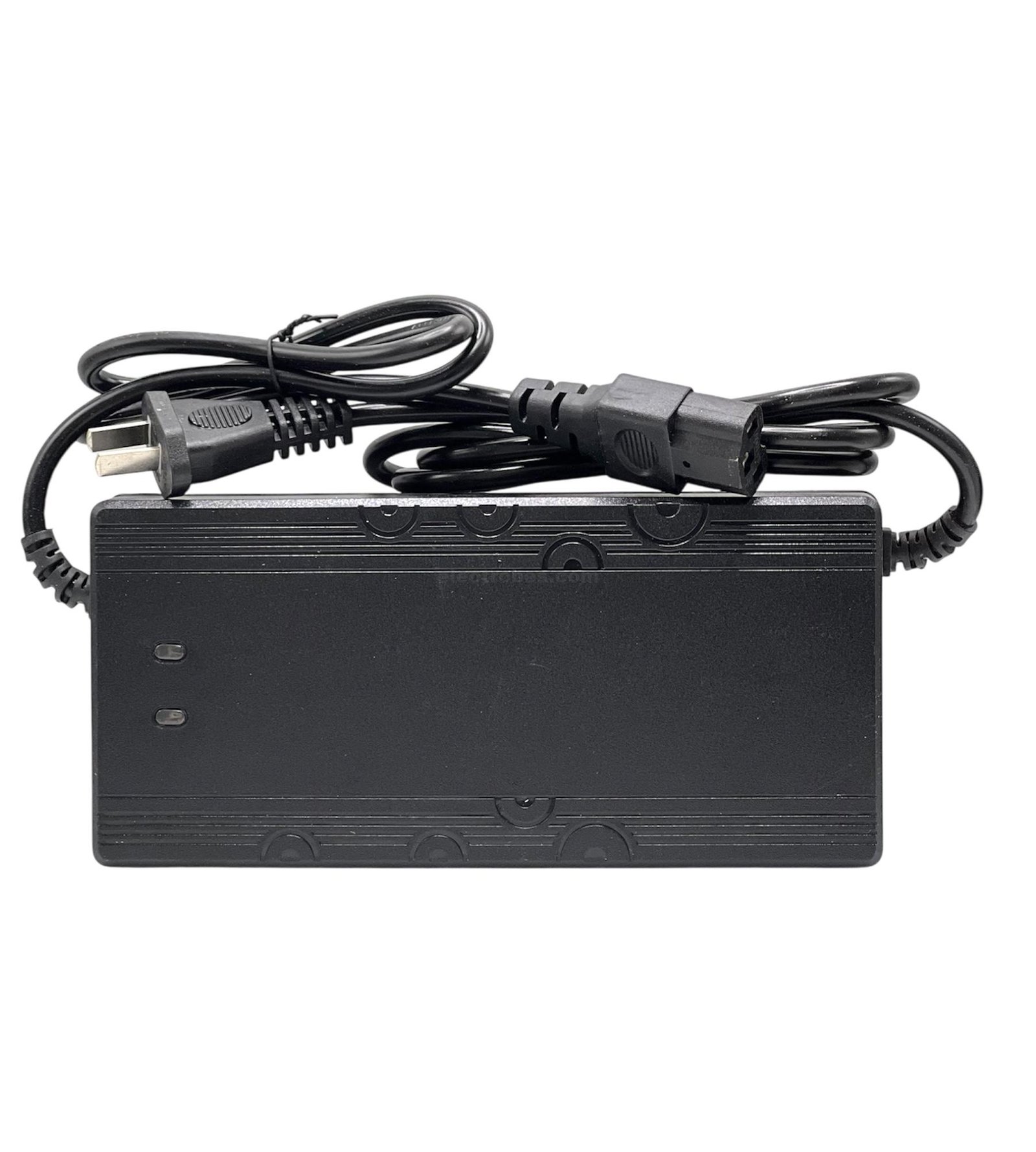
## Introduction: Why Rickshaw Chargers Differ from E-Bike Chargers
Electric rickshaws (passenger e-rickshaws) and electric cargo loaders are the commercial backbone of urban transit and wholesale logistics across Lahore, Karachi, Rawalpindi, Faisalabad, and Multan. Unlike lightweight 2-wheeler electric bikes which feature 20Ah to 30Ah batteries, commercial 3-wheelers operate on massive 80Ah to 200Ah battery banks.
Using an undersized charger (e.g. 2A to 4A) on a 100Ah rickshaw battery pack will require 30 to 50 hours of continuous operation, causing severe thermal stress on the transformer, degrading internal capacitors, and failing to trigger the vital absorption cutoff.
---
## 1. Matching Voltage: 48V, 60V, or 72V?
Pakistani electric 3-wheelers operate on three distinct nominal system voltages:
- 48V Systems (4x 12V Batteries): Common in smaller passenger rickshaws (e.g. Crown Falcon, Jolta).
- - Nominal: 48V
- - Full Float Cutoff (Lead-Acid): 8V
- - Full Cutoff (16S LiFePO4): 4V
- 60V Systems (5x 12V Batteries): The dominant standard for passenger rickshaws in Pakistan (Sazgar Lilong, Crown CR-Electric, New Asia Navo, Qingqi).
- - Nominal: 60V
- - Full Float Cutoff (Lead-Acid / Tubular): 5V
- - Full Cutoff (20S LiFePO4): 0V
- 72V Systems (6x 12V Batteries): The industry standard for 1-ton cargo loaders and heavy passenger models.
- - Nominal: 72V
- - Full Float Cutoff (Lead-Acid / Traction): 2V
- - Full Cutoff (24S LiFePO4): 6V
> [!WARNING] > Never connect a 72V charger to a 60V or 48V battery pack! The excessive voltage will cause violent boiling of lead-acid electrolyte, melt internal plates, and cause catastrophic fire on lithium batteries.
---
## 2. Choosing the Right Current (Amperage)
Charger current ($I$) directly dictates recharge speed. The golden rule for deep-cycle lead-acid/tubular batteries is a charging current between 15% and 20% of the battery Ampere-hour (Ah) rating ($0.15C$ to $0.2C$):
$$\text{Recharge Time (Hours)} \approx \frac{\text{Battery Capacity (Ah)} \times 1.25}{\text{Charger Output (A)}}$$
- 100Ah Battery Pack: Requires a 15A to 20A charger (recharges in 5 to 6.5 hours).
- 120Ah to 150Ah Battery Pack: Requires a 20A to 25A charger (recharges in 6 to 7.5 hours).
- 180Ah to 200Ah Cargo Loader Pack: Requires a 25A to 30A commercial fast charger.
---
## 3. Connector Standards & Polarity Verification
High currents (15A–30A) generate substantial contact resistance heat. Pakistani commercial rickshaws utilize three primary connector systems:
- Anderson SB50 (Gray/Red 50A): The standard for passenger rickshaws (Sazgar, Crown). Compact and self-wiping.
- Anderson SB120 (120A Heavy Duty): Mandatory for commercial cargo loaders pulling continuous 25A+ charge currents.
- Industrial 3-Pin Round 32A: Common on Qingqi models with metal body chassis sockets.
Always measure polarity with a digital multimeter before plugging in for the first time.